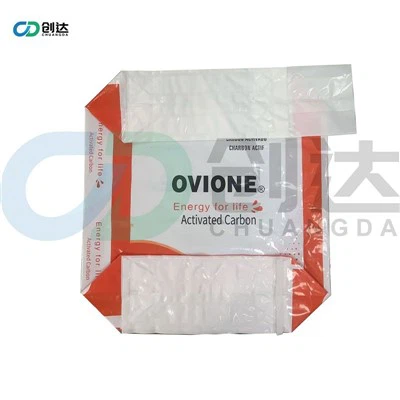


Core Specifications of Flexographic Printing PE Square Bottom Bag
Flexographic printing PE square bottom bag retain the structural advantages of block-bottom designs while incorporating the characteristics of flexographic printing. That's why their specifications are designed to balance flexibility and cost. Here's a detailed breakdown of their classifications.
Let's start with size and capacity. These bags are mainly divided into three types based on their uses. Small-sized bags usually range from 200×200×300mm to 400×400×600mm. They can't hold too much, roughly between 1kg and 10kg. They're perfect for packaging things like snacks and small samples of daily necessities.
Medium-sized bags are larger, with dimensions ranging from 500×500×800mm to 700×700×1000mm. They can hold 10kg to 30kg. Common agricultural products like rice and flour, as well as detergents, are often packaged in these.
Large-sized bags are the biggest, with sizes from 800×800×1200mm to 1000×1000×1500mm. They can carry 20kg to 30kg. Fertilizers, feed, and granular construction materials often use these large bags for packaging.
Next, let's look at material and printing layer specifications. There are different material combinations available. For simple printing, a single layer of PE is enough. This single-layer PE can be either HDPE or LLDPE, with a thickness between 15μm and 50μm.
But if you need functional packaging, like moisture-proof or fresh-keeping packaging, you'll need a composite structure. Composite structures can be PE plus a heat-sealable layer-EVA is a commonly used heat-sealable layer, for example. Or they can be PE plus a barrier film, and PVA is a great choice for such barrier films.
In terms of printing layers, regular printing usually uses 1 to 4 colors, which is suitable for printing text and simple patterns. For gradient printing, flexographic screening technology can achieve 3 to 6 color transitions. Although its precision is slightly lower than that of gravure printing, the cost is much lower.
Then there are the printing process parameters. The resolution of flexographic printing, measured by screen lines per inch, is usually 80 to 133. It's good for printing medium to low-precision patterns. Text and lines can be printed clearly, but the delicacy of gradient colors is a bit weaker.
There are also different types of inks. Water-based inks are environmentally friendly and non-toxic. They can directly contact food, meeting the GB 9685 standard, and they dry quickly. UV inks have strong weather resistance, making them suitable for outdoor use, but they cost a bit more than water-based inks.
Finally, let's talk about load-bearing capacity and structural details. These bags can hold between 10kg and 30kg. The bottom is reinforced by folded-edge heat sealing or stitching. The printing area avoids key load-bearing parts, like the folded edge of the bottom, which won't have any printing.
In addition, some special designs can be added, such as easy-tear lines, handle holes, and exhaust valves. These functional structures won't affect the printing effect.
Unique Advantages of Flexographic Printed PE Block-Bottom Bags
Advantages Of The Printing Process
Environmental friendliness is a standout feature. It mainly uses water-based inks, with almost zero VOC (volatile organic compound) emissions. This complies with current "green packaging" policies, such as China's Emission Standards for Volatile Organic Compounds in Packaging and Printing Industry. So it's especially suitable for packaging food and daily necessities.
Another big advantage is the low cost of short-run printing. It doesn't require complex plate roller engraving, and the plate-making cycle is short, usually taking 1 to 3 days. The minimum order quantity can be as low as 1000 pieces, which is perfect for small to medium batch customization, like e-commerce retail packaging and specialty agricultural product packaging.
Material And Function Adaptability
Flexographic printing has good compatibility with flexible materials. Because its printing pressure is low, it has little impact on the stretching and deformation of PE films. So it's suitable for ultra-thin PE, such as PE below 50μm, or elastic PE materials, which can prevent the bag from breaking during printing.
It also has strong expandability with functional inks. It can print functional coatings like anti-static, anti-slip, and anti-counterfeiting ones. For example, anti-static inks can be used in the packaging of electronic components to prevent static electricity from damaging the products. Temperature-sensitive inks change color when heated, which can indicate the freshness period of food.
Production And Application Advantages
In terms of production, it can quickly change plates and achieve mass production. Flexographic printing machines can change plates in a short time, about 30 minutes, which is suitable for multi-variety, small-batch production. For example, it's easy to switch between different SKU product packages on e-commerce platforms.
It can also print on curved and irregular surfaces. Flexographic plates are elastic, so they can print evenly on parts like the folded edges and rounded corners of block-bottom bags, avoiding the edge ghosting that might occur with gravure printing.
Balance Between Cost And Flexibility
The overall cost is manageable. The plate-making cost is 50% to 70% lower than that of gravure printing, and ink consumption is also low because the anilox roller of flexographic printing delivers ink precisely. This is very friendly to small and medium-sized enterprises with limited budgets.
Design modifications are also flexible. If you need to adjust the printed pattern, such as changing text content logos, the cost of modifying flexographic plates is low, and there's no need to re-engrave the plate rollers.
Expansion Of Applicable Scenarios
In agricultural and fresh product packaging, it can be used for rice, grains, fresh fruits, etc. Through the environmentally friendly inks of flexographic printing, the combination of "degradable packaging + clear origin labeling" can be achieved.
It's also suitable for FMCG retail packaging. For daily necessities like washing powder and detergents, the multi-color text instructions printed by flexographic printing, such as usage guides and ingredient lists, make the information easier to read.
In e-commerce logistics packaging, courier bags and buffer bags can be printed with brand logos and logistics information, which not only plays a promotional role but also has practical functions.
Comparison With Other Printing Processes
Compared with other printing processes, each has its own characteristics. Let's briefly talk about them from the aspects of environmental friendliness, short-run cost, printing precision, applicable materials, and typical scenarios.
Flexographic printing has good environmental friendliness, low short-run cost, medium printing precision, and is suitable for flexible PE and degradable materials. Typical application scenarios include agricultural products, e-commerce packaging, and food bags.
Gravure printing has average environmental friendliness and high short-run cost, but high printing precision. It's suitable for composite films and thick PE, with typical scenarios being high-end industrial packaging and long-term storage.
Offset printing has good environmental friendliness, medium short-run cost, and relatively high printing precision. It's suitable for paper and films, with typical scenarios being labels and instructions.
Customization Considerations
Pattern design needs to be optimized. Flexographic printing is not suitable for printing extremely fine lines, such as lines less than 0.1mm, nor is it suitable for high-precision gradients. It's recommended to use color blocks and thick-line text in the design to avoid pattern distortion.
Ink drying tests are also important. Water-based inks may dry slowly in high-humidity environments. So it's necessary to test in advance to see if the printed bags will stick together when stacked.
Matching the material thickness is also crucial. Ultra-thin PE, such as PE below 30μm, is easy to stretch during printing. It's recommended to choose materials with a thickness of 50μm or more, or add anti-stretching masterbatch.
Hot Tags: flexographic printing pe square bottom bag, China flexographic printing pe square bottom bag manufacturers, factory, Flexographic Printing PE Square Bottom Bag, Gravure Printing PE Square Bottom Bag, Heavy Duty PE Block Bottom Bag, Industrial Dust Protection PE Bags with Square Base, PE Ion Exchange Resin Packaging, pe square bottom bag